On My Way
A crow is sitting on a wall watching me. This is a Colombo crow, which means it has opinions and no particular fear of expressing them. We look at each other for a moment. I decide not to make it weird and keep walking.
 Chanuka Nadun
6 min read
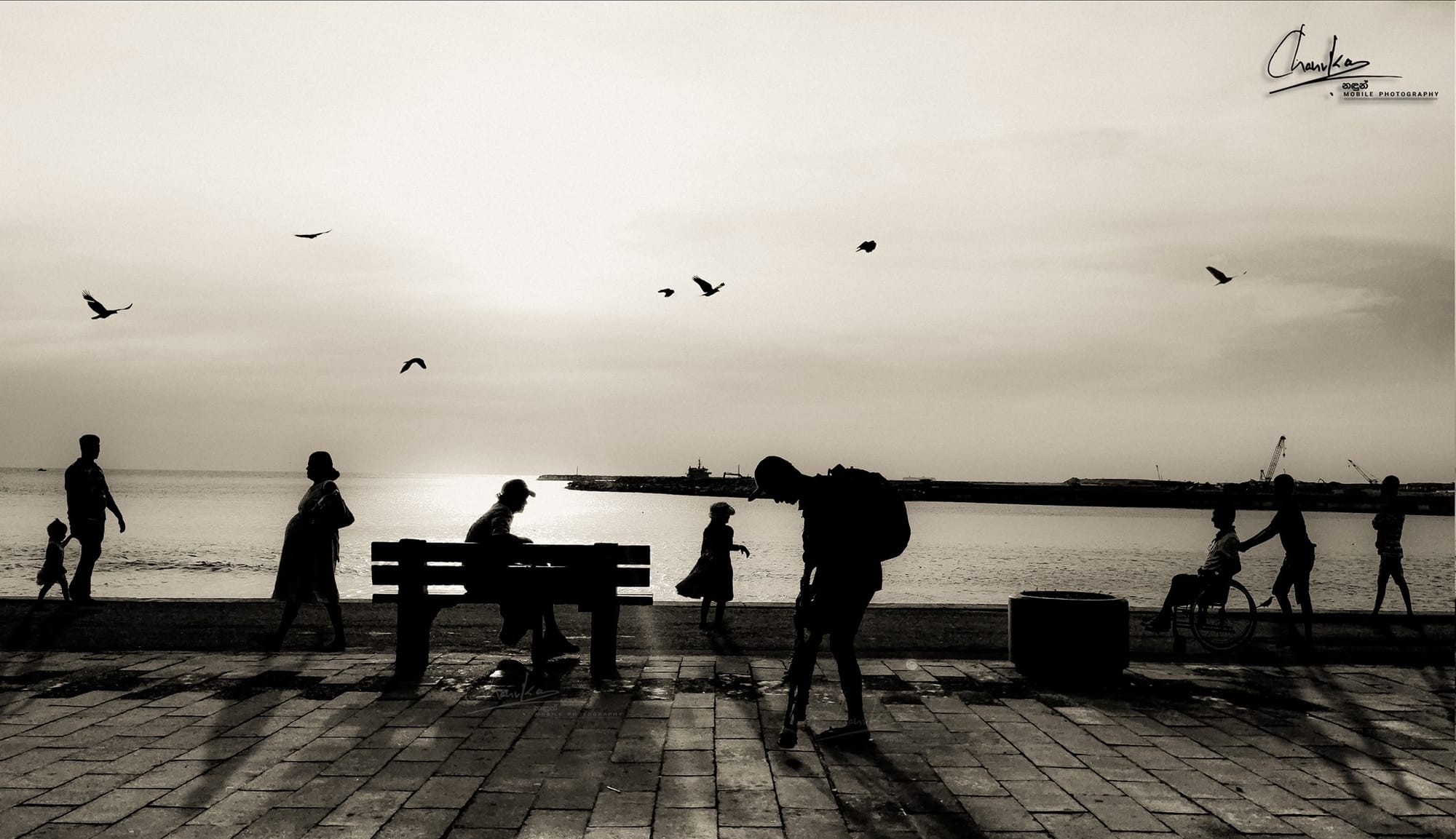
Colombo empties out the day before Aluth Awurudu in a way that feels almost rude. The city, which spends the rest of the year being aggressively, inescapably itself, just quietly packs up and leaves. Everyone goes back to wherever they're actually from. The traffic dissolves. The noise drops to something almost dignified. What's left is the skeleton of the place, the roads, the buildings, the street lamps doing their small honest work, and people like me who apparently don't have anywhere better to be.
I've been walking down Galle Road for a while now. Not toward anything specific, or at least that's what I told myself when I left. The kind of walking you do when your head has too much in it, and your room has too little space for all of it. The street lamps along this stretch throw a color that isn't quite yellow and isn't quite white, something tired and in between, like light that's been standing here too long and knows it. It doesn't illuminate so much as suggest. I find that more honest than brightness.
Galle Road on a normal night doesn't give you much choice about how you walk. You're always adjusting, half a step left, tucking in, timing yourself around people coming the other way. Tonight, there's just enough space to walk without thinking about it. Not empty, but loose. The crowd thinned to something almost comfortable. Everyone went back to their people for the new year. I'm walking toward the sea, which is either poetic or just what happens when you don't have a village to go back to.
A crow is sitting on a wall watching me. This is a Colombo crow, which means it has opinions and no particular fear of expressing them. We look at each other for a moment. I decide not to make it weird and keep walking. The crow watches me go, which I choose to interpret as respect and not indifference.
A friend of mine, someone I've always thought was genuinely wise and who occasionally proves me wrong about that, once told me that life is like a highway. I asked him to explain. He said figure it out yourself. I spent years being irritated by that. Lately, I think he either had no idea and performed certainty so well that it became indistinguishable from wisdom, or he understood that some things only become true when you find them yourself. Both readings make me trust him less and respect him more at the same time, which is probably what he intended.
The honest answer, the one I've arrived at slowly and with considerable argument with myself, is that the only reliable witness to who I actually am is me. Not the version I present in rooms, not the version that shows up in photographs, but whatever part of me has been watching all of it. That part has seen the embarrassing drafts. The nights are negotiating with myself to bring the pain down to a manageable level. The 3 a.m. versions of things. It was there for all of it, and it doesn't rewrite the record to be kind, which is more than I can say for memory in general.
What I didn't expect, and what took longer than it should have to understand, is that loneliness was the thing that pushed me here. I spent years treating it like a problem to be solved, and then one day, I can't tell you exactly when, it started feeling like a condition that had something to teach. The loneliness pushed me into writing. The writing pushed me into something that is more honestly me than most things I've built since. A poet I read once wrote something about how, when the world pushes you toward destruction, try writing instead. I'm not quoting accurately, but the idea landed somewhere; it hasn't left.
I first fell in love with the world through books before I had the chance to be disappointed by it directly. I was young when I wrote a school essay imagining what a pen would say if it could speak, and the teacher read it to the class, which was the most mortifying and quietly wonderful thing that had happened to me up to that point. I hadn't invented anything. I had borrowed from every book I'd read, which was already more than my age warranted.
By thirteen, I was the kind of person the Beddagana library staff described to each other at the end of shifts. I'd arrive in the morning and return in the evening to swap whatever I'd finished. The staff took a fixed lunch break every day, leaving only the security guard, who approached sleep the way professionals approach expertise, quickly and completely. This created a window. The adult section had books that the children's section didn't have, and I had no patience for waiting until I was technically authorized. I got caught eventually, not at the library, but at school, which I had skipped to go there. The beating I received for skipping school to read books is still, objectively, one of the most absurd things that has happened to me. I went back the following week.
That habit gave me a permanent feeling of being slightly older than whatever room I was in. Not wiser, just older. More comfortable with people who have years on me than with people my own age. It's been useful occasionally. More often, it's been a reliable way to be humbled by someone who has actually lived the things I've only read about.
Galle Face is closed now. I can feel the air change before I can see the sea, that particular openness that happens when the land runs out of reasons to continue.
I see a monk walking ahead of me along the esplanade, unhurried in the way that either means great peace or very sore feet, and something in my memory catches. A few years ago, I watched a crowd of people who identify as followers of a man who spent his life teaching impermanence and the letting go of attachment, gathered in reverent excitement over a book title engineered specifically to sell.
I sat with that image for a long time. My first thought was ungenerous. My second was that the Buddha might have just been a man from this island who needed to walk until things made sense, and kept walking long enough that people started following him and writing things down. Standing here now, watching this monk move quietly through an emptied Colombo on the eve of the new year, I find myself wondering if he ever felt like this. The wandering is not a method but the only honest response to not knowing. Whether he ever just walked because the room was too small.
We build frames and then forget we built them. The religion, the nationality, the family's particular way of seeing things, we receive all of it before we're old enough to ask whether we want it, and then spend the rest of our lives treating the frame as though it were the picture. The frame becomes structural. You try to remove it, and everything feels like it might fall. Most people decide the frame is fine. Some people spend their lives quietly, carefully, taking it apart piece by piece to see what's actually there. I'm not sure which one I am. I'm still in the middle of it.
I reach Galle Face and find a place to sit near the water. The sea at this hour is doing nothing dramatic. It's just the sea, present and indifferent in the way that large things are indifferent, not hostile, just operating at a scale where your specific concerns don't register. I find that more comforting than I probably should.
The city behind me is quiet. Not for long, Wednesday everyone comes back, the traffic returns, Colombo reassembles itself into the thing it performs every day. But tonight it's still just this. The road I walked down, the sea in front of me, whatever I've been carrying this whole walk that I haven't fully named and probably won't.
I'm not going to name it. That's not what tonight is for.
A few drops of rain come in from nowhere, not enough to matter, just enough to notice. Out near the horizon, there's lightning, silent at this distance, the kind that lights up the edge of the sky for half a second and then leaves you wondering if you imagined it.
My phone rings. It's Amma.
I look at the sea one more time. It doesn't offer anything. It never does.
I tell her I'm on my way. And I am.